
Title Options
AI Can Walk the Job But Only You Can Work It
What AI Cannot Replace On Site
Your Job Walk Just Got Automated
AI technology has transformed how we document construction sites, but it has not replaced the human element that makes field professionals irreplaceable.
The Documentation Shift
Five years ago, if you were the only one who had fresh photos of the job site, that alone made you valuable.
Today, tools like OpenSpace, EarthCam, Buildots and Holobuilder by FARO Technologies can do automated job walks with 360° cameras and AI.
2025 has been a tipping point year of adoption for these and other tools.
They know exactly what is installed where, what is delayed, how many pallets are sitting idle, even where safety is being ignored.
What Gets Replaced
So if your field presence is just stopping by, snapping a few photos, and writing some vague notes, that is the part AI is already replacing.
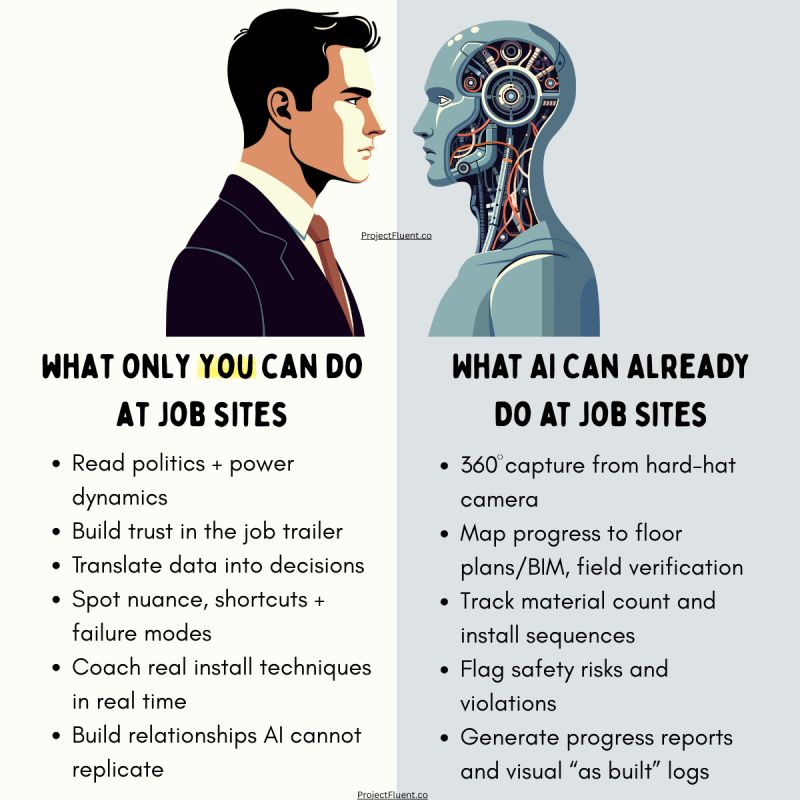
AI can capture 360° views from hard hat cameras.
It can map progress to floor plans and BIM, handle field verification.
It tracks material count and install sequences.
It flags safety risks and violations automatically.
It generates progress reports and visual as built logs.
What Still Matters
Where you still win is everything AI cannot replicate.
Reading politics and power dynamics on site.
Building trust in the job trailer.
Translating data into decisions.
Spotting nuance, shortcuts, and failure modes before they escalate.
Coaching real install techniques in real time.
Building relationships AI cannot replicate.
Your Competitive Edge
AI handles the documentation.
You handle the relationships and the judgment.
You become the person they call first when something goes sideways on site.
That is where we are diving deep in Thursday's Field-Ready Strategy Session.
Conclusion
The automation of job walks does not mean the end of field professionals. It means the value has shifted from documentation to judgment, from presence to impact, and from recording what happened to preventing what could go wrong.
Follow me on LinkedIn or Substack for more insights on navigating construction technology.